Every artist has areas they’d like to improve, and for me one of those was translating another artist’s vision into a fully realised 3D character.
While browsing the work of various concept artists, I found several illustrations whose strong silhouettes and expressive designs immediately caught my attention. Rather than creating original characters, I challenged myself to faithfully interpret these existing concepts in three dimensions, treating each one as a study in observation, analysis and artistic problem-solving.
Unlike production concept sheets, these illustrations often consisted of a single image. That meant much of the design simply didn’t exist beyond what was visible. The back of a character, the volume of a limb, the way forms connected together and how materials behaved all had to be carefully interpreted while remaining true to the original artist’s intent.
Over the course of these studies I recreated three characters, each presenting a different set of challenges.
Tentacle Head
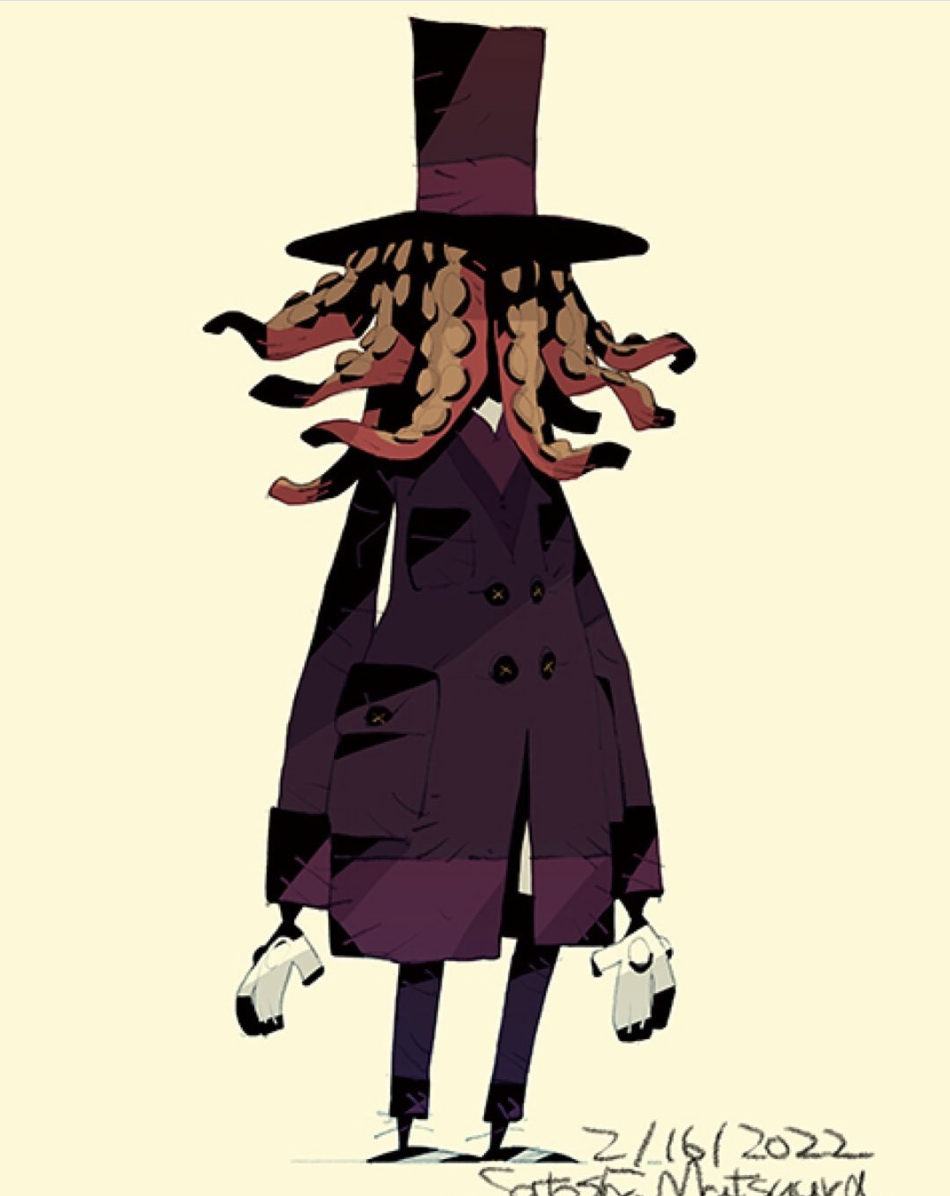
The first study was inspired by an illustration by Satoshi Matsuura, based on the creature from Gogol. The Beginning.
What immediately drew me to the piece was its striking silhouette and unsettling personality. Working from a single illustration meant many aspects of the creature had to be interpreted, from the hidden anatomy to how the tentacles wrapped and connected to the body. My goal wasn’t to redesign the character, but to understand the original artist’s intent well enough to recreate it convincingly in three dimensions.
Mushroom Fighter
The second study was based on an original concept by Tyler Grayson Ellis. (Brendan Milos Portfolio)
Compared to Tentacle Head, this character presented a completely different challenge. Rather than relying on unsettling organic forms, Mushroom Fighter embraced bold, stylised shapes and a playful personality. Preserving that charm while making the character believable from every angle required careful attention to proportion, silhouette and the relationships between large, medium and small forms.
The project reinforced how much of a character’s appeal comes from design decisions made long before any modelling begins.
Squished
The final study was inspired by an illustration by Sketchy Adams (SketchyAdamsArt).
By this stage, the modelling itself had become less of the challenge. Instead, the focus shifted towards analysing why the original design worked. Every exaggeration, every proportion and every curve served a purpose. Rather than asking, “How do I build this?”, I found myself asking, “Why did the artist make this decision?”
That change in mindset proved to be the biggest lesson from the series. The goal of translating concept art into 3D isn’t simply accuracy—it’s understanding the visual language of another artist well enough to preserve their intent while solving all of the problems a two-dimensional illustration leaves unanswered.
What These Studies Taught Me
Although each character was visually different, all three projects explored the same underlying skill: interpreting a two-dimensional illustration as a fully realised three-dimensional character.
These studies taught me to:
Analyse a concept before beginning production.
Preserve silhouette and personality above unnecessary detail.
Infer hidden forms from limited visual information.
Make informed artistic decisions while remaining faithful to another artist’s intent.
Think like both a concept artist and a 3D artist throughout the modelling process.
Perhaps the biggest lesson was that translating concept art into 3D isn’t about producing an exact copy. It’s about understanding the design well enough to answer all of the questions that a static illustration leaves unanswered.
As a 3D artist, that’s a skill I continue to rely on today. Whether working from rough sketches, polished concept sheets or production artwork, every project requires careful interpretation before the first polygon is ever placed.